The music
Two Chopin pieces, explained
The Revolutionary Étude and the Heroic Polonaise, the two Chopin pieces named for the Warsaw recitals: what they are, their nicknames and what to hear.
Reserve a recital seat ↗Quick answer
The Revolutionary Étude is Chopin's Étude in C minor, Op. 10 No. 12, a piece for the left hand's fast running notes beneath a singing right hand. The Heroic Polonaise is his Polonaise in A-flat major, Op. 53, from 1842. Both are named in the hall's concerts, but the programme varies, and neither is promised on a given date.
Why these two
The organiser names the Revolutionary Étude and the Heroic Polonaise as examples of what is played at the hall. The polonaise is described as one of Chopin's most admired works, so a first-time listener may well know it. The programme varies by pianist and date, and no fixed pieces are promised, so treat the two as a way into the music rather than a checklist. Hearing them in a room of this size shows how much each piece asks of the player.
The Revolutionary Étude
The piece is the Étude in C minor, Op. 10 No. 12, the last of the first set of twelve studies. Chopin wrote it around 1831. Its challenge is for the left hand, which plays evenly running semiquavers from start to finish, while the right hand carries widely spaced octaves in long, smooth melodic shapes. The set was dedicated to Franz Liszt, who is named in the dedication as the composer's friend. The word étude means a study, and Chopin's studies are concert pieces as well as exercises.
How it got its name
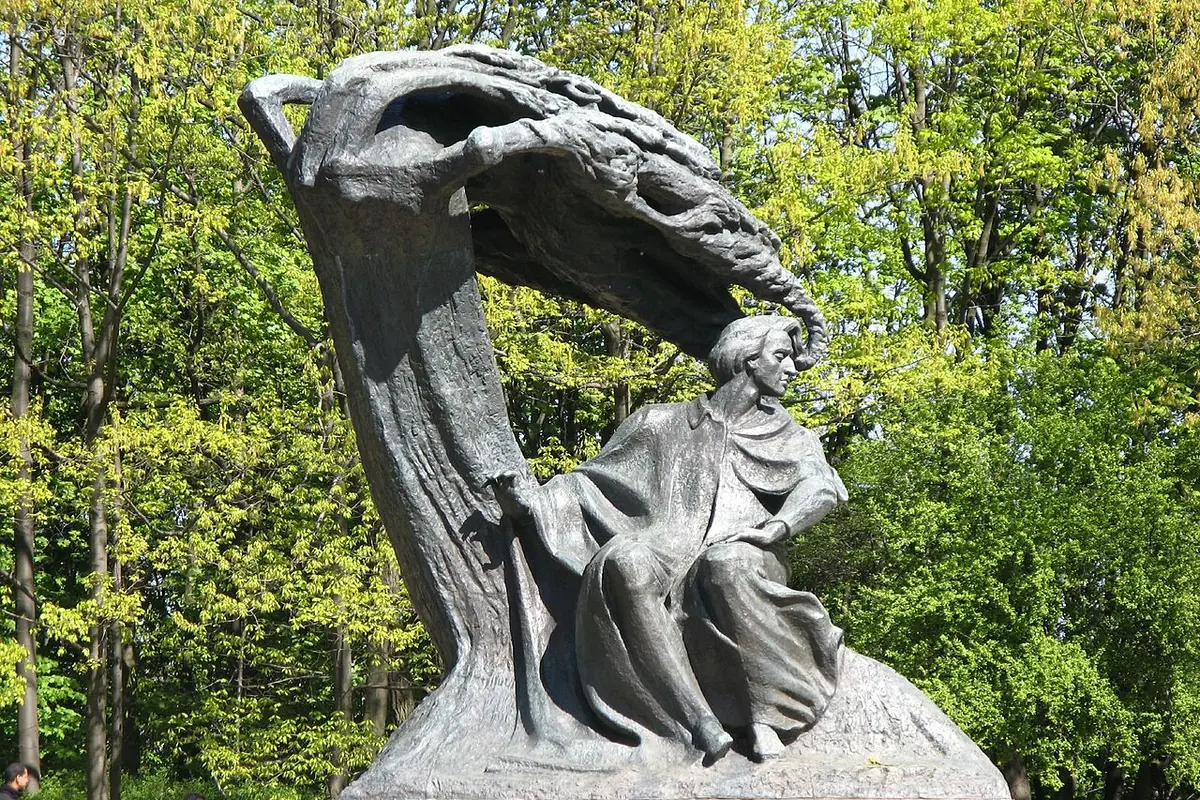
The title Revolutionary Étude, also given as the Étude on the Bombardment of Warsaw, is a nickname. A popular legend ties the piece to the 1831 Battle of Warsaw, but the story is considered apocryphal. Listen to it as a study with real drama rather than as a battle report.
The Heroic Polonaise
The Polonaise in A-flat major, Op. 53, dates from 1842 and was published in 1843. It is dedicated to Auguste Léo, a German banker and friend of Chopin. A polonaise is a Polish dance form, and this one is built on a grand scale. The nickname Heroic is linked to George Sand, who wrote to Chopin that it should be a heroic symbol, although Chopin was reluctant to give his music descriptive names. Chopin is reported to have played it more gently than most performers do.
Where the études sit in his work
The Revolutionary Étude closes the first set of twelve études, Op. 10, which Chopin dedicated to his friend Franz Liszt. The études are short pieces, each exploring a particular technical challenge and each written as music in its own right. Hearing one in a recital shows why pianists treat them as concert pieces, and why a programme can include a few alongside nocturnes and polonaises.
What to listen for
In the étude, follow the left hand's unbroken run and notice how the octaves above it sing. In the polonaise, listen for the rapid octave passages that make it famously demanding, and for the stately rhythm that holds them together. Pianist Arthur Rubinstein called it the composition closest to his heart. A small room lets you hear both hands clearly.
Hearing them in a small room
A compact hall changes how both pieces sound. In the étude you hear the left hand clearly instead of as a blur, and in the polonaise the loud passages fill the room. That closeness is the practical reason to hear Chopin in a small hall: the player's hands, the pedal and the quietest notes are all within reach of your ears.
Will you hear them
Not necessarily. The hall's concerts include pieces such as these two, but the pianist and the programme change with the date, and the booking page does not promise a particular work. If one piece decides your visit, check the entry for your date and be ready to enjoy something else. Chopin's catalogue is large, and a programme can draw on his nocturnes, mazurkas, waltzes and ballades as well.
Frequently asked questions
What is the Revolutionary Étude?
Chopin's Étude in C minor, Op. 10 No. 12, written around 1831, with a fast left-hand run under a singing right hand.
What is the Heroic Polonaise?
Chopin's Polonaise in A-flat major, Op. 53, composed in 1842 and published in 1843.
Will they be played at my concert?
Possibly, but not promised. The programme varies by pianist and date.
Sources